Monday

Design Influence for the 2009 Southern Accents Showhouse


When I first met with Larry Boerder to discuss the design of the 2009 Southern Accents Showhouse, I explained my love of Cotswold architecture and how I would like to incorporate it into the Showhouse.  

After traveling to England years ago and spending time in the countryside of the Cotswolds region I was hooked on the design.  One of my favorite buildings of all was The Lords of the Manor inn in Upper Slaughter (the picture with the car in the motor court) which was originally a manor house.  Village after village was full of the architecture that has stood the test of time.  Buildings and homes are mostly all built of Cotswold stone which is a yellow oolitic limestone and the roofs are made of a slate stone.

For the Southern Accents Showhouse, Larry did an outstanding job of designing the house to appear as if it had been added on to over the years (see the rendering in my original post).  The stone we are using, while not yellow, is a close resemblance to a weathered stone and the closest I have found in the U.S. for the proper look.  Ours will be more of a cream and gray color and will have a gray slate roof similar to some of the pictures.

The pictures here are from the Cotswold area.  I hope you enjoy.


Wednesday

Furniture for the French House

While the main focus of my blog is the design of period revival houses, from time to time I'll offer insight into what would be appropriate for the interior of these houses as well.  When I come across "finds" for a house I'll make you aware of them.

Here I am giving some pictures of reproduction French furniture that would look great in any French styled house.  While the settee is a Swedish design, I love it for a French look as well.  All of these pieces can be finished in at least two colors.  I have also included a picture of a antique French Trumeau mirror that my wife fell in love with.  The problem is that it is $12,500.  So, I am working on reproducing one that is similar that is about 4' wide by 8' tall.  Once I have built, painted, gold leafed and glazed the reproduction mirror I am going to decide if I want to make more to sell.  I'll let you know.  For now, if you would like to buy any of the pieces above please email me for more information.  Merry Christmas.


French Village: An Inspiration for Development

In the 1920's a developer by the name George Woodward was a busy man building and developing in the area of Chestnut Hill in Philadelphia.  Woodward began developing very modest homes years earlier, but after travels to England and France (and working with the famed architect Wilson Eyre) he developed Cotswold Village.  The houses were created from Woodward's love of the Cotswold country side.  They were all built around 1915-18 and were built with chiseled local cut stone and steep roofs.  

In the 1920's, Woodward decided to create a development that mimicked his love of the old stone farmhouses he had seen while traveling in the Normandy region of France.  These houses are beautiful examples of French Normandy architecture in the United States.  It is examples like this that inspired me to do what I do.  If it could have been built in the 1920's, it can certainly be done today in my city of Fort Worth or anywhere.  Woodward obviously had a very keen eye for details and a true understanding of scale.  The houses posted here are located on Gate Lane and the pictures come from the George Woodward Co. which is still in existence today as a real estate company in Philadelphia.  I will cover more of the Philadelphia area in other posts as there are great examples of period revival architecture from architects like Mellor, Meigs and Howe.  I hope you enjoy these photographs.


Tuesday

Sconces for an English House


While we are in the framing stage of building the 2009 Southern Accents magazine Showhouse, we are working on all of the details: door hardware, lighting, beams, kitchen design, tile selections, plumbing fixtures, etc.

One of my favorite building products to find is lighting.  As I've discussed in a previous post, lighting is not an easy selection to make.  At least, the correct lighting is not easy.  If you are going to build or remodel a house in a particular style, the lighting is one component that should match the design of the house.  Careful attention to the correct style can make the design of your house cohesive and beautiful.

The pictures I have included today are of interior and exterior sconces that I am considering using for the 2009 Southern Accents magazine Showhouse.  As I noted in the post on Spanish Colonial lighting, some of these could be used for Spanish Colonial houses but most of these today are exact reproductions of sconces that came out of English styled houses from the 1920's and 1930's.  I hope you enjoy seeing these and if you would like more information on buying any of these please send me an email for pricing, sizing, etc.

Wednesday

Door Hardware for a Period Revival House


Finding the correct door hardware for your house is a very difficult thing.  Most people go to their local hardware distributor to pick out their door knobs or levers and select from the few selections that the largetst companies offer or the ones that are samples at the showroom.  This usually consists of selections that don't coincide with the style of their house.

Historically, door hardware was made to precisely fit the design of the house.  However, there are many hardware designs that are suitable for multiple house designs.  For example, as in lighting, you will find that some English styles would be appropriate with Spanish and Italian houses.

The door hardware examples above consist of English and French styles but several can be used in a Mediterranean style house as well.

While this is just a small sample of beautiful door knobs and levers, it will give you a feel for what is correct to use in your English, French or Mediterranean style house.  In future posts I will give more examples or if you would like to contact me for recommendations, how to purchase these (and more) or just general guidance please do so.

Friday

Spanish Colonial Lighting


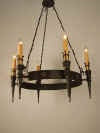
One step in creating a feel of a 1920s or 30s Spanish Colonial house is selecting the correct lighting.  There are many chandeliers and sconces made today that are inexpensive and unfortunately chosen by homeowners
 and builders because of expense or a lack of knowledge of what is appropriate for the design of the house.
However, the good news is that there is great lighting available.  And not only for Spanish Colonial houses.  In addition, the cost is not enormous.  What makes these chandeliers and sconces so unique is that are made from a cast from original lights from the 1920s and 30s.

The ones I have included today are for a Spanish Colonial house.  They can also be used in any style of Mediterranean architecture as well as a few other styles.  If you would like more information on these or would like to purchase some, please let me know.