Friday, January 30, 2009

Modern Twist on Classical Designs -- Part II

Okay, I've been flooded with emails about my post yesterday.  I guess I've struck a chord that makes me realize I'm not the only one that loves modern adaptations of classical and period revival homes.  The work that some talented architects are doing simply amazes me with their incredible eye for detail, scale and proportions.  Their imagination and ability to take what they see in their head and put it on paper sometimes astounds me.  As I wrote yesterday, there are many failures in trying to do this.  However, another architect (who trained under Bobby McAlpine) is doing it very, very well.  I recently came across his work and have already become a huge fan.  His name is Ruard Veltman and his staff of Ruard Veltman Architecture in Charlotte, North Carolina.  They describe their company as "an atelier residential firm, fluent in a range of historical styles without being bound by tradition."  The designers render their drawings by hand which I love.  While I am not an architect, I do design many of the homes we build.  I have been a student of architecture for many years, drawing floor plans and rearranging furniture since I was 11 years old and I find it impossible for someone to truly put their creative imagination for a design into a computer without drawing or sketching it out first.

Here are some pictures of Ruard Veltman Architecture's work.  The first home is what he calls Jacobean Tudor:

Look at this wine storage.  Incredible.

Here is Ruard's take on a Mediterranean style:

I believe the above picture is a basement level wine room.  The below pictures are of his take on an English Cottage:

Ruard is a very talented architect and I'm looking forward to seeing more of his work.  If you know of any architects doing similar work, please forward their information to me.


Thursday, January 29, 2009

Modern Twist on Classical Designs

Modern adaptations of classical architecture have their place.  It is very easy to completely destroy what started out as a great design.  I see it all the time on additions to old houses.

However, when done right and an architect puts his spin on period revival architecture the outcome can be outstanding.  One of the best I know of for doing this is Bobby McAlpine and his partner Greg Tankersley of McAlpine Tankersley.  They describe their work as "nurturing, compassionate, soulful," the firm's architecture, wedding historical precedence with graceful modern living, is a timeless and romantic pursuit of "The Inheritable House".

And do they ever.  What is even more amazing is that their firm is headquartered in little Montgomery, Alabama.  You know how us Southerners (I'm from Baton Rouge) love great architecture.  Below are some pictures of their work.  These pictures came from both Southern Accents and Veranda.

The picture above and directly below are of Bobby McAlpine's house he built in Montgomery quite a few years ago.  He has since sold it and restored another house.

The three pictures above are of a house I saw when I was visiting family in Memphis and taking my early morning architecture drive (I do this in every city I visit).  At the time, I didn't know it was a McAlpine-Tankersley house but it caught my eye from 500' away.

The next two pictures are of Greg Tankersley's personal house.


I'll do more posts on modern adaptations of period revival homes and the architects who are doing great work.


Wednesday, January 28, 2009

Homes We've Built in Fort Worth -- Part II The Interiors

As promised in my previous post, below are a few pictures of the interiors of some of our work over the past few years.  I hope you enjoy.

The above picture is the entry hall of an Italian Renaissance house.  We built the custom made doors that lead to the powder bath and coat closet to fit the antique Verre eglomise which, according to Betty Lou Phillips, is a reverse painting on glass.  The limestone slab floor is from Ann Sacks.  A local artisan hand painted the metallic gold banding and then glazed over the gold bands and silver walls.

This bathroom for our client's daughter consists of 1920's era tile floor and a reproduction vanity that is based on an antique commode our clients had found.

This loggia is my favorite we have done.  The brick flooring was salvaged from one of Fort Worth's oldest streets and encompasses the entire front porch and side loggia.

This powder bath is much more than just a powder bath.  The antique fountain, turned into a pedestal sink, was a chore to make work with the water flowing out of the mouth of the sun face, but the outcome is spectacular.  The venetian walls were done by the same local artisan mentioned above (as were many rooms in the house) and the window surround is limestone.

The other daughter's bathroom is my favorite.  With white Thassos tile, a 1920's era pedestal sink (although it is new) and soft green walls make it a true 1920's style bathroom.

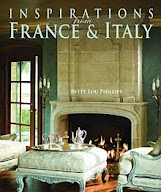
All of the above pictures are from an Italian Renaissance style house in Fort Worth we built and the pictures are out of Betty Lou Phillips beautiful book, Inspirations from France & Italy.  If you don't have a copy of this book you need to add it to your library.  Betty Lou has an incredible eye for beautiful homes.


These two pictures come out of a French eclectic house we did last year.  The client, who is a very talented interior designer, was very specific in her selections and searched long and hard for the furnishings and pieces to be built in.  From the 3" limestone floors filling much of the downstairs, the antique columns, the antique mantels, the antique chandeliers and sconces, the antique iron entry doors and the Gracie wallpaper in the dining room, this house is a true showplace.

Monday, January 26, 2009

Homes We've Built In Fort Worth

Since starting my blog last month, I have had several emails asking for pictures of some of the houses we've built in Fort Worth.  My company does both remodeling of Period Revival style homes and we build new homes based on historical designs.  Here are some pictures of a few of the projects we've done over the years.  I apologize that some of these photos were taken recently so the landscape isn't as pretty as it will be in a few months.  Once the good weather returns and everything is more colorful I'll replace the pictures with the new ones.  Hope you enjoy.

This house you've probably already seen in earlier posts.  This house was originally built as a one story and previous owners found plans hidden in the walls dated 1929 before the stock market crash.  Today's owners hired us to carry out the plans very similar to what was to be done 75 years earlier.
The above French eclectic house started out as a 1940s vernacular.  My client desired a French style home, so I designed it to face what was previously the side street but one of Fort Worth's most prominent streets.  We added the entire front side and almost doubled the size of the original  house.  Using many antique building products like the clay tile roof, the front door surround and the antique french iron doors that the owner found, the house now fits in with the rest of the neighborhood of homes built in the 1920's and 30's.  Most people think that this is one of the street's original houses.
This limestone-clad French style house is in a small new development tucked in the middle of old Fort Worth.

This Spanish colonial house was one of the first new homes we built and is based on a Santa Barbara design. 

Another complete remodel and facade alteration, this home was originally a 1940's ranch style home that we doubled in size and turned into a Spanish Colonial hacienda style.

This historic eclectic English tudor is set in a beautiful setting in one of Fort Worth's oldest neighborhoods.  The entire left side of the house is an addition that we did several years ago.  At the time, the city would not allow additions on the front of any of the "Historically Significant Homes" of Fort Worth, but after working with the city and showing them the quality of the addition and attention to details they allowed it.

Another complete remodel and addition to match the original 1920's design, this home sits prominently looking over Rivercrest Country Club golf course.


This English Cotswold designed house also sits right across from the country club.  Clad in a stone to mimic the Cotswold stone and a door surround taken from the great English designs of the Philadelphia area, this home is admired by many for the close attention to English details.

I'll continue to add more pictures of homes we've done and their interiors as well in future posts.

Wednesday, January 21, 2009

Trumeaus--Reproduction or Antique?

Mirrors are a great statement throughout a house and often overlooked in decorating.  It is usually in the finest homes you find outstanding French and Italian mirrors.  The French trumeau became popular in the 18th century and were found in homes in France up until the mid-1800's.  Some of these mirrors were built into paneling in walls in these homes.  This type of mirror is called a boiserie--it is often difficult to tell the difference unless it is obvious that the sides of the mirror have been removed from a wall.  

Today, I love a large trumeau leaning against a wall, a gilded mirror in a powder bath, an Italian mirror above a console or bureau.  That is one of the reasons I am starting to make authentic reproduction mirrors based on actual antiques.  Well, to be honest, most of these outstanding mirrors command a hefty price that doesn't fit in our household budget (which is probably the same with many people).  In addition, most every reproduction I have seen is simply not done correctly.  The mirrors I am designing now are as close to the originals as I have found, with relief carvings that were originally designed over 100 years ago in the U.S. by European carvers.  My goal is to eventually have a selection of French trumeaus and some Italian mirrors to offer for sale.  All of the details of these mirrors will be exact or close to it with the carvings that originated in Europe.  Below are some examples of the designs I am working on.  The first one is one of my favorites and is my first project:


Tuesday, January 20, 2009

Reader Poll: Your Favorite Italian Console

What is it about French and Italian houses that gets everyone so excited?  Although I've only written a handful of posts, the ones on French and Italian designs get, by far, the most response.  Of course I've had a lot of response to the Southern Accents Showhouse post as well.  I guess it's more great design than anything that piques people's interest.

When it comes to furnishing a period revival house, as I've written before, I do not mind mixing styles.  If you have a English style house I love a mixture of French antiques.  If you prefer a French styled house, Italian furnishings work great as well.

As for me, we have always lived in a period revival style house.  A couple of years ago, someone called and asked if they could buy our Tudor style house.  Within 16 hours we had a contract signed and we moved in 3 weeks.  It was a whirlwind.  We couldn't find a house to buy and were searching quite furiously.  My friend and realtor called and wanted me to look at a house in an area I didn't particularly want to live in--made up of mostly all ranch style houses from the 1960's.  I didn't even want to look at it.  She talked me in to looking at it--a typical American vernacular that ended up having some curb appeal with six beautiful live oaks in the front yard.  My first thought was, "I can do something with this".  I called my wife, asked her to look at it and her response was the same--"I don't want to live there".  I encouraged her to look at it and once she did, she said, "You better put a contract on this".  

All of this to say, we now live in a 1961 typical vernacular house (almost completely remodeled) that we are filling with furnishings mixed in French and Italian styles that have nothing to do with the exterior.  But we love it.

My newest projects for the house are a new dining room table, an enormous French trumeau and an Italian console for the powder bath sink.  All of these I am building, finishing and some will have gold leafing and glazing.

Right now, I am torn on exactly what I want the Italian style console to look like.  This is where I'd love your help.  Which do you prefer?  Please send me a email or leave a post to which of the consoles below you like best.  I'll let you know which gets the most votes.  The easy thing for me to do would be to just purchase one of these, but with prices ranging from $9,000-$45,000, I think the prudent thing to do would be to make a reproduction.   I love all of these, just trying to narrow down which one I want to make first.  My plan is to eventually start production on several of these to offer for sale (as well as the mirror).  I look forward to hearing from you.


Monday, January 12, 2009

Details of the Spanish Colonial House

With all of the feedback I've gotten from readers about the homes of Hollywood stars, I thought I'd give some insight into the architectural details that these homes from the 1920's an 30's would most likely have had built in to them.

Of course, since I started with Spanish-style homes of stars, I thought I'd show you what would be appropriate for this type of architecture.

Spanish-style homes have always had an abundance of iron details. This included (and should in today's homes as well) iron window grilles, iron stair railings, iron work on doors, you could even have a steel pennant flying above your entry as Rudolph Valentino did.


Some of these pictures came from Steve Giannetti's great website at www.giannettiarchitects.com

The above pictures are great examples of window grilles that can easily be duplicated today. If you need help in getting the correct scale, materials, etc., send me an email and I can help.

While most Spanish-style houses are clad in stucco, painted brick is another option although I prefer stucco. However, go to www.monarchestates.com and look at The Ranch House at Shady Canyon that David Ko of Robert Hidey Associates designed--a great example of painted brick.

So many new home builders today apply stucco in a synthetic finish that just does not do justice to traditional stucco. Hand troweled, smooth stucco (and sometimes lumpy) gives a finish that is hard to beat.


The above picture is from the Four Seasons Biltmore in Santa Barbara. My wife and I have been here a few times (and taken our family) and absolutely fell in love with the place and the town. What a beautiful example of Spanish Colonial architecture the Four Seasons is. With the hand-troweled stucco, the simple iron railing details, the simple iron sconce, the tile stair treads, the deep-set window. This is how it should be done.

Doors are another important architectural detail that, when done correctly, can make a Spanish-style entry stand out. Period style hardware (as shown in my hardware post), iron details, and a speak-easy are a few details that will show that you know what you are doing when it comes to appropriate style.
I hope these examples have given you a small glimpse of some of the exterior features that should be used in a Spanish Colonial house and ones that were most likely very common in the houses that some Hollywood stars lived in in the 1920's and 30's. Once again, attention to details is key in designing a beautiful home.

Thursday, January 8, 2009

The Hollywood House

Since the 1920's, Hollywood stars have been known as the style setters for society.  This was (and is) true when it comes to their homes as well.  Wallace Neff, the well known architect to the stars in the 20's and 30's, was the architect that many stars hired to design their homes.

Throughout Beverly Hills and the surrounding area, homes were designed in many different styles that the silver screen set desired with Spanish Colonial and Italian Renaissance being the dominant ones (although there were many built in both English and French styles).  Some were quite opulent while others were very simple--I guess depending on the actors lifestyle.

Even in the 1950's, movie stars bought up the houses that were built 20-30 years earlier for former stars.  Most all of these homes are great examples of Period Revival architecture.  Some of today's stars are following suit like Diane Keaton and Reese Witherspoon.

The photographs here are Spanish-style homes that were built in the 20's in Beverly Hills and the surrounding area except for Reese Witherspoon's which is in Ojai outside Santa Barbara.

Rudolph Valentino's Falcon Lair, with a steel pennant with a "V" above the entrance

W.C. Field's house in Encino

Wallace Berry's Spanish Baroque style house

Reese Witherspoon's recent purchase in Ojai

Producer Joe Pasternak's Spanish-style on Beverly Drive in Beverly Hills

Diane Keaton's new remodel

Many of these photographs come from Mark Wanamaker's collection, the Mark Wanamaker/Bison Archives.  He can be contacted at bisonarchives@yahoo.com.

While there are obviously many more, these are some of my favorites in the Spanish style.  In future posts I'll cover the interior and exterior products that are appropriate for these type of homes, although if you look at my post on lighting for Spanish Colonial houses any of those would be perfect for these houses.  I'll cover appropriate roofs, stucco finishes, tile, furniture, mantels.  Be sure to check back.

Saturday, January 3, 2009

The Interior of an Italian Renaissance House

While designing a house in the Italian Renaissance style is not an easy task, with all of the proper details and scale, furnishing one can be difficult as well.  With a little research, hard work and attention to appropriate styles of mantels, lighting and architectural details you can accomplish the look.  In addition, finding the appropriate furniture is important as well.  Today I am focusing on the mantels and some mirrors/artwork that are appropriate (along with a couple of chandeliers) to help you.

With the arrangement of rooms for today's living, I like to classify certain architectural details (like mantels) for certain areas of the house. In original Italian houses, most every room used by the owners were formal. Today’s home is much different, as we all use every room in the house.  Today, formal areas should have more formal mantels, etc.  For a living room, dining room or any formal area here are some styles that are great depending on the formality of your house.


These are two reproduction mantels that, with their heavy carving, would be appropriate for your formal areas.

The two below are antique mantels that would be appropriate for either formal or informal (say a family room). However, I would use both of them in either place.


The mirrors below, and the portrait, are perfect examples of pieces that would be great for an Italian Renaissance house.  Of course, I am not opposed to using French Trumeau’s such as the one mentioned in my French Interiors post to go above the mantels shown above as well.


Here are two more pieces that are great to incorporate.  The commode can be used in many places.  In my previous post on Italian Renaissance houses I showed a picture of a house we built/remodeled in Fort Worth.  My clients found a piece similar to this commode that I had built and an artist finished the work for their daughter's bathroom vanity.  They also found a fountain similar to the one below that we converted into a pedestal sink for their powder bathroom by carefully drilling  holes in the back and mounting a wall mount faucet.  More pictures of both the commode and the fountain pedestal can be found in Betty Lou Phillips book, Inspirations from France & Italy.


These chandeliers are great examples of what would be appropriate for an Italian Renaissance house.  While I love all of them, I particularly love the last one which is a 17th Century reproduction that I can get for you for about $1,700.  I have actually ordered one for my own house.


Friday, January 2, 2009

The Italian Renaissance House

Italian Renaissance style architecture is found throughout the United States in early 20th century houses.  To me, the Italian Renaissance house, with it's low-pitched roof (usually covered in ceramic tile), arched windows and doorways, porches and intricate details like cut stone, decorative brackets and broad eaves is one of the most beautiful.  Most of these houses were architect-designed landmarks in major metropolitan areas.
The house above was built in the Indian Village area of Detroit, probably for a prominent auto-industry executive.  Notice the symmetry, the large eave, the limestone door surround.  This is a beautiful example.

This house is one of my favorites.  Not only because my company built it, but also because every aspect of this house was built and designed to match how it would have been done in the 1920s or 30s.  The original house was a simple one story house built in 1915.  Prior owners had found plans dated 1929 inside the walls of the house by local architect Joseph Pelich.  The story goes that the owners had plans to do the work in 1930, but two months later the stock market crashed followed by the Depression put the plans on hold and they never did the work.  The current owners hired us to do carry out the plans (the new plans incorporated most of the details of the 1929 plans, but updated for today's living).

The entire second story was added, most of the first level was completely gutted and the location of the front door was altered to face the street.  This was one of the most challenging jobs we have faced and the outcome is beautiful.  It was a fun job, as the architectural plans were very precise, the details immaculate and we had great clients to work with.  It is now a landmark house in a beautiful area of Fort Worth.  You can find more examples in Betty Lou Phillps book, Inspirations from France & Italy.


 Here's another perfect example in Indian Village, Detroit.


The above pictures are other great examples of Italian Renaissance style.  The top picture is the famous Vizcaya in Palm Beach.  The next is a David Adler designed house in Chicago.  The bottom two are of a house in Atlanta designed by Philip Shutze.


Monday, December 29, 2008

Design Influence for the 2009 Southern Accents Showhouse


When I first met with Larry Boerder to discuss the design of the 2009 Southern Accents Showhouse, I explained my love of Cotswold architecture and how I would like to incorporate it into the Showhouse.  

After traveling to England years ago and spending time in the countryside of the Cotswolds region I was hooked on the design.  One of my favorite buildings of all was The Lords of the Manor inn in Upper Slaughter (the picture with the car in the motor court) which was originally a manor house.  Village after village was full of the architecture that has stood the test of time.  Buildings and homes are mostly all built of Cotswold stone which is a yellow oolitic limestone and the roofs are made of a slate stone.

For the Southern Accents Showhouse, Larry did an outstanding job of designing the house to appear as if it had been added on to over the years (see the rendering in my original post).  The stone we are using, while not yellow, is a close resemblance to a weathered stone and the closest I have found in the U.S. for the proper look.  Ours will be more of a cream and gray color and will have a gray slate roof similar to some of the pictures.

The pictures here are from the Cotswold area.  I hope you enjoy.


Wednesday, December 24, 2008

Furniture for the French House

While the main focus of my blog is the design of period revival houses, from time to time I'll offer insight into what would be appropriate for the interior of these houses as well.  When I come across "finds" for a house I'll make you aware of them.

Here I am giving some pictures of reproduction French furniture that would look great in any French styled house.  While the settee is a Swedish design, I love it for a French look as well.  All of these pieces can be finished in at least two colors.  I have also included a picture of a antique French Trumeau mirror that my wife fell in love with.  The problem is that it is $12,500.  So, I am working on reproducing one that is similar that is about 4' wide by 8' tall.  Once I have built, painted, gold leafed and glazed the reproduction mirror I am going to decide if I want to make more to sell.  I'll let you know.  For now, if you would like to buy any of the pieces above please email me for more information.  Merry Christmas.