Friday

Modern Twist on Classical Designs -- Part II

Okay, I've been flooded with emails about my post yesterday.  I guess I've struck a chord that makes me realize I'm not the only one that loves modern adaptations of classical and period revival homes.  The work that some talented architects are doing simply amazes me with their incredible eye for detail, scale and proportions.  Their imagination and ability to take what they see in their head and put it on paper sometimes astounds me.  As I wrote yesterday, there are many failures in trying to do this.  However, another architect (who trained under Bobby McAlpine) is doing it very, very well.  I recently came across his work and have already become a huge fan.  His name is Ruard Veltman and his staff of Ruard Veltman Architecture in Charlotte, North Carolina.  They describe their company as "an atelier residential firm, fluent in a range of historical styles without being bound by tradition."  The designers render their drawings by hand which I love.  While I am not an architect, I do design many of the homes we build.  I have been a student of architecture for many years, drawing floor plans and rearranging furniture since I was 11 years old and I find it impossible for someone to truly put their creative imagination for a design into a computer without drawing or sketching it out first.

Here are some pictures of Ruard Veltman Architecture's work.  The first home is what he calls Jacobean Tudor:

Look at this wine storage.  Incredible.

Here is Ruard's take on a Mediterranean style:


I believe the above picture is a basement level wine room.  The below pictures are of his take on an English Cottage:


Ruard is a very talented architect and I'm looking forward to seeing more of his work.  If you know of any architects doing similar work, please forward their information to me.


Thursday

Modern Twist on Classical Designs

Modern adaptations of classical architecture have their place.  It is very easy to completely destroy what started out as a great design.  I see it all the time on additions to old houses.

However, when done right and an architect puts his spin on period revival architecture the outcome can be outstanding.  One of the best I know of for doing this is Bobby McAlpine and his partner Greg Tankersley of McAlpine Tankersley.  They describe their work as "nurturing, compassionate, soulful," the firm's architecture, wedding historical precedence with graceful modern living, is a timeless and romantic pursuit of "The Inheritable House".

And do they ever.  What is even more amazing is that their firm is headquartered in little Montgomery, Alabama.  You know how us Southerners (I'm from Baton Rouge) love great architecture.  Below are some pictures of their work.  These pictures came from both Southern Accents and Veranda.


The picture above and directly below are of Bobby McAlpine's house he built in Montgomery quite a few years ago.  He has since sold it and restored another house.


The three pictures above are of a house I saw when I was visiting family in Memphis and taking my early morning architecture drive (I do this in every city I visit).  At the time, I didn't know it was a McAlpine-Tankersley house but it caught my eye from 500' away.

The next two pictures are of Greg Tankersley's personal house.


I'll do more posts on modern adaptations of period revival homes and the architects who are doing great work.


Wednesday

Homes We've Built in Fort Worth -- Part II The Interiors

As promised in my previous post, below are a few pictures of the interiors of some of our work over the past few years.  I hope you enjoy.

The above picture is the entry hall of an Italian Renaissance house.  We built the custom made doors that lead to the powder bath and coat closet to fit the antique Verre eglomise which, according to Betty Lou Phillips, is a reverse painting on glass.  The limestone slab floor is from Ann Sacks.  A local artisan hand painted the metallic gold banding and then glazed over the gold bands and silver walls.


This bathroom for our client's daughter consists of 1920's era tile floor and a reproduction vanity that is based on an antique commode our clients had found.

This loggia is my favorite we have done.  The brick flooring was salvaged from one of Fort Worth's oldest streets and encompasses the entire front porch and side loggia.

This powder bath is much more than just a powder bath.  The antique fountain, turned into a pedestal sink, was a chore to make work with the water flowing out of the mouth of the sun face, but the outcome is spectacular.  The venetian walls were done by the same local artisan mentioned above (as were many rooms in the house) and the window surround is limestone.

The other daughter's bathroom is my favorite.  With white Thassos tile, a 1920's era pedestal sink (although it is new) and soft green walls make it a true 1920's style bathroom.

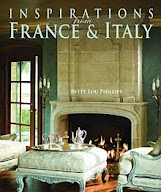
All of the above pictures are from an Italian Renaissance style house in Fort Worth we built and the pictures are out of Betty Lou Phillips beautiful book, Inspirations from France & Italy.  If you don't have a copy of this book you need to add it to your library.  Betty Lou has an incredible eye for beautiful homes.


These two pictures come out of a French eclectic house we did last year.  The client, who is a very talented interior designer, was very specific in her selections and searched long and hard for the furnishings and pieces to be built in.  From the 3" limestone floors filling much of the downstairs, the antique columns, the antique mantels, the antique chandeliers and sconces, the antique iron entry doors and the Gracie wallpaper in the dining room, this house is a true showplace.

Monday

Homes We've Built In Fort Worth

Since starting my blog last month, I have had several emails asking for pictures of some of the houses we've built in Fort Worth.  My company does both remodeling of Period Revival style homes and we build new homes based on historical designs.  Here are some pictures of a few of the projects we've done over the years.  I apologize that some of these photos were taken recently so the landscape isn't as pretty as it will be in a few months.  Once the good weather returns and everything is more colorful I'll replace the pictures with the new ones.  Hope you enjoy.

This house you've probably already seen in earlier posts.  This house was originally built as a one story and previous owners found plans hidden in the walls dated 1929 before the stock market crash.  Today's owners hired us to carry out the plans very similar to what was to be done 75 years earlier.
The above French eclectic house started out as a 1940s vernacular.  My client desired a French style home, so I designed it to face what was previously the side street but one of Fort Worth's most prominent streets.  We added the entire front side and almost doubled the size of the original  house.  Using many antique building products like the clay tile roof, the front door surround and the antique french iron doors that the owner found, the house now fits in with the rest of the neighborhood of homes built in the 1920's and 30's.  Most people think that this is one of the street's original houses.

This limestone-clad French style house is in a small new development tucked in the middle of old Fort Worth.

This Spanish colonial house was one of the first new homes we built and is based on a Santa Barbara design.

Another complete remodel and facade alteration, this home was originally a 1940's ranch style home that we doubled in size and turned into a Spanish Colonial hacienda style.

This historic eclectic English tudor is set in a beautiful setting in one of Fort Worth's oldest neighborhoods.  The entire left side of the house is an addition that we did several years ago.  At the time, the city would not allow additions on the front of any of the "Historically Significant Homes" of Fort Worth, but after working with the city and showing them the quality of the addition and attention to details they allowed it.

Another complete remodel and addition to match the original 1920's design, this home sits prominently looking over Rivercrest Country Club golf course.


This English Cotswold designed house also sits right across from the country club.  Clad in a stone to mimic the Cotswold stone and a door surround taken from the great English designs of the Philadelphia area, this home is admired by many for the close attention to English details.

I'll continue to add more pictures of homes we've done and their interiors as well in future posts.

Wednesday

Trumeaus--Reproduction or Antique?

Mirrors are a great statement throughout a house and often overlooked in decorating.  It is usually in the finest homes you find outstanding French and Italian mirrors.  The French trumeau became popular in the 18th century and were found in homes in France up until the mid-1800's.  Some of these mirrors were built into paneling in walls in these homes.  This type of mirror is called a boiserie--it is often difficult to tell the difference unless it is obvious that the sides of the mirror have been removed from a wall.  

Today, I love a large trumeau leaning against a wall, a gilded mirror in a powder bath, an Italian mirror above a console or bureau.  That is one of the reasons I am starting to make authentic reproduction mirrors based on actual antiques.  Well, to be honest, most of these outstanding mirrors command a hefty price that doesn't fit in our household budget (which is probably the same with many people).  In addition, most every reproduction I have seen is simply not done correctly.  The mirrors I am designing now are as close to the originals as I have found, with relief carvings that were originally designed over 100 years ago in the U.S. by European carvers.  My goal is to eventually have a selection of French trumeaus and some Italian mirrors to offer for sale.  All of the details of these mirrors will be exact or close to it with the carvings that originated in Europe.  Below are some examples of the designs I am working on.  The first one is one of my favorites and is my first project: